Walk the Walk
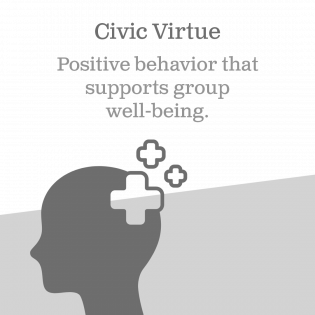
Learners explore what it means for responsible citizens to demonstrate civic virtues of justice, kindness, peace, generosity, and inclusion.
The learner will:
- describe civic virtue through justice, inclusion, generosity, kindness and peace.
- sticky notes, enough for each participant to have eight self-stick notes (may designate a color for each civic virtue)
- paper outline of a person
Make a life-size outline of a person on poster board or a flattened box.
Instructions
Anticipatory Set:
Introduce a life-size cardboard/paper “citizen” who they will bring to life by breathing into it civic virtues that a citizen needs. Brainstorm qualities of citizens that supports the well-being of all. Civic virtues may include justice, kindness, generosity, peace and inclusion. Write these around the citizen figure.
In this activity, they will be exploring how these civic virtues can be demonstrated through actions.
Move the participants into groups by which virtue they want to focus on. In their group, they discuss what they could DO to be just; DO to be kind and generous; DO to be peaceful; or DO to be inclusive. For example, peace may look like compromising on an issue. Inclusion may be listening to other points of view, or being respectful of individual identities. They write these on sticky notes (their group gets a distinct color of notes.)
Ask each group write a summary statement about their civic virtue exhibited by the “citizen.” They will prepare to share the description of the virute with the whole group and put some sticky notes on the citizen outline. They also think of ways to illustrate their virtue and put it on the citizen outline.
Review the definition of philanthropy – to give time, talent, and treasure and take action for the common good.
After listening to all the groups describe their virtues, they write a personal goal to perform a small philanthropic act that exhibits one of the virtues, benefiting not only themselves but also the common good.
The goal is reasonable and can be completed by a designated time.
Philanthropy Framework
-
Strand PHIL.II Philanthropy and Civil Society
-
Standard PCS 01. Self, citizenship, and society
-
Benchmark HS.4 Describe and give examples of characteristics of someone who helps others.
-
-
Standard PCS 05. Philanthropy and Government
-
Benchmark HS.2 Discuss civic virtue and its role in democracy.
-
-