Learning to Give, Curriculum Division of The LEAGUE

The LEAGUE

Beginning of the Storm (The )
Lesson 1:
printEmail this Lesson
Lesson
Handouts
Academic Standards
Philanthropy Framework

Purpose:

Using award winning literature, the learners will describe and analyze bigotry in Mississippi during the Great Depression. They will also define and give examples of community capital in the rural community where the story takes place and explain the importance of family. Learners will recognize the authors techniques that convey meaning and build empathy with readers.

Duration:

Five Forty-Five Minute Class Periods

Objectives:

The learners will:

  • define and use the vocabulary of Reconstruction and the Great Depression.
  • define and give examples of community capital in the story.
  • evaluate the author’s use of dialect in the novel.
  • identify how families contribute to the socialization of their children.
  • evaluate how individuals and families cope with discrimination in the story.

Service Experience:

Although this lesson contains a service project example, decisions about service plans and implementation should be made by students, as age appropriate.

After completing the novel, arrange a trip for students to go to a local senior citizens’ home. Assign each student (or pair) to a senior. Have the students talk to the seniors about how their community has changed since they were teenagers. Discuss the importance of family and what kind of influence families had on their own beliefs. When the students have completed the interview, ask them to type out copies to give to the seniors. Then ask to make a bulletin board in both the senior home and at school, relating their experiences.

Materials:

  • Copy of African-American gospel music from the time period (for example: Testify! The Gospel Box [see Bibliographical References]).
  • Teacher reference: Historical Background (Attachment One)
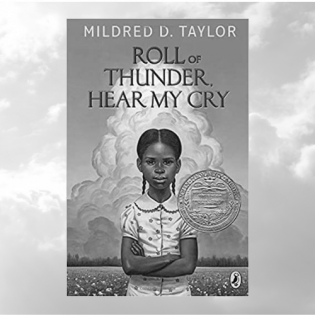
  • Student copies of Roll of Thunder, Hear My Cry
Handout 1
Historical Background

Instructional Procedure(s):

Anticipatory Set:
When the learners are seated, turn off the lights and ask the learners to listen closely to gospel music. When the song is complete, ask them their thoughts on the song, when they think it was written, why it was written and how they feel it would have affected the people of the time. (Note: Begin each succeeding class period with the playing of the same gospel song to set the tone of the story and the times.).

  • Provide a short background of the time frame of the book for the learners. Historical Background (Attachment One) may be used. Make sure students understand the specific historical vocabulary that pertains to this period.

  • Distribute the novels. Ask the students to read the novel like a play and assign characters whenever possible (including a narrator role which may rotate).

  • Note that the novel is written in the dialect of the people and is meant to be read in that fashion. Ask students why the author would choose to write using the dialect of the people. What advantages does it give the reader? What disadvantages are there in its use?

  • Note: If a chapter is not completed in class, assign the rest of the chapter for students to read at home (if individual copies are available). This lesson covers the first four chapters of the book.

  • As the class gets further into the book, ask them to make observations on the importance of the family and community to the different cultures in the book. How would individuals “make it” without the support of their families and community?

  • Explain that when various members of the community work together to solve a problem, this can create community capital, that is, a positive attitude between groups which carries over into good will toward each other and the ability to work together to solve the community’s problems. Ask the learners to note examples of community capital in the story. (This is on-going throughout the book.) Have students evaluate the value of community capital in the small rural community where times are hard. Do the learners believe there is community capital in their school and in the local community? If so, give examples.

  • Stop during the reading of the novel to discuss situations of distress, disrespect or discrimination. Note how the parties involved handle the situations and the effectiveness/ineffectiveness of those actions. Identify how the families in the story contribute to the socialization of their children in good and bad situations.

Assessment:

  • To ensure that students have a strong comprehension of what is occurring in the novel, give small, five-question mini-quizzes at the end of each chapter.

  • After several chapters have been read, you may give a larger quiz (or small test) over the chapters covered stressing characterization, community capital, the families, and their belief structures.

School/Home Connection:

Ask the students to ask their parent(s) or guardian what family beliefs and structures were passed down to them from their parents. Ask them how they feel community capital has changed since they were in middle school. Ask the students to write down the responses and discuss their findings in class.

Extension:

After completing Roll of Thunder, Hear My Cry, read Jazmin’s Notebook by Nikki Grimes (New York: Puffin Books, 1998) and discuss how a fourteen-year-old African-American girl deals with her stresses in 1960s Harlem. Compare with Cassie in 1933 Mississippi.

Bibliographical References:

  • Taylor, Mildred. Roll of Thunder, Hear My Cry. New York: Puffin Books, 1991.

  • Various Artists. Testify! The Gospel Box. Rhino Records. June 15, 1999.

Lesson Developed and Piloted by:

Dana Dixon
St. Joseph Public Schools
Upton Middle School
St. Joseph, MI 49085

Handouts:

Handout 1Print Handout 1

Historical Background

  • The Civil War in the United States was fought from 1861-1865. When the war was over, many Southern landholders lost their lands due to the lack of available money to pay the taxes on the land. The land was often bought by Northerners who came South to make money during the hard times (carpetbaggers) or others who had access to funds after the war.

  • When the war was over, many Southern state legislatures passed Black Codes. These were laws that restricted the freedom and movement of freedmen in the South. Black Codes restricted freedmen to jobs in agriculture or as domestic laborers. Harsh vagrancy laws were passed which would fine wandering persons without jobs. If they could not pay the fine, they could be hired out against their wills to anybody who would pay the fine in return for their labor.

  • Few freedmen had land after emancipation. As a result they had no choice but to work as sharecroppers. In this system a family (black or white) would be given a section of land to farm and then were allowed to keep a share of whatever they grew while they paid the rest as rent. Because cotton prices stayed low after the war until 1900, sharecroppers barely earned enough to stay alive. They often owed the landlord or the local storeowner more than they made from the crop.

  • After the Civil War, secret groups (Ku Klux Klan, the Mississippi Society of the White Rose, etc.) terrorized the countryside in the South, flogging, maiming, tar-and-feathering and sometimes killing blacks who tried to vote or who, in other ways, tried to be equal to whites. Congress passed the Ku Klux Klan Acts to outlaw these organizations; these laws had little effect.

  • Segregation was enforced by the passage of Jim Crow laws after the war. In 1896 the Supreme Court case of Plessy v. Ferguson approved segregated facilities that were“ separate but equal.” Separate schools (and other facilities such as washrooms and public transportation) existed for the races but the facilities were not equal.

  • The Great Depression occurred from the time of the stock market crash of 1929 to the beginning of World War II. Farmers were hard hit but especially those who were sharecroppers in the South. They were not slaves but were “tied” to the land by the debt they owed. Since they had no capital (money), the only way they could buy seeds for the next crop and food and clothing for their families was to pledge their profits from the crop in advance. If they had a bad crop, they were in debt with no way to pay what they owed. For many sharecroppers, they could not make enough to survive on the land but they were not able to leave. A large number of black laborers moved from the South to the North during the 1930s since conditions were so hard in the South. Even though there was a high unemployment rate in the nation’s northern cities in the 1930s, there was a better chance of earning money than as a sharecropper.

Philanthropy Framework:

Comments

Megan, Teacher – Manistee, MI10/28/2007 8:03:48 PM

(The positive aspect of using this lesson was) the students were interested in the concept of "community capital" that people working together can be worth something tangible. I thought this was especially appropriate for my students who live in our small town.

Michelle, Teacher – Belmont, MI10/28/2007 8:05:29 PM

(The positive aspect of using this lesson was) providing students with examples of community captial because they hadn't realized it goes on in their everyday lives. I really liked the inclusion of historical background.

Submit a Comment

All rights reserved. Permission is granted to freely use this information for nonprofit (noncommercial), educational purposes only. Copyright must be acknowledged on all copies.

Copyright © LearningToGive.org