Building Sensitivity and Awareness
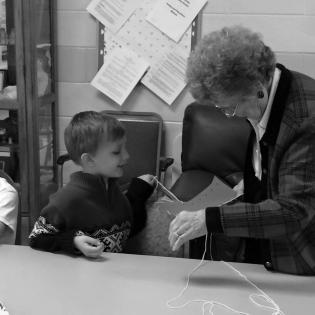
This lesson introduces the "Living History Project." We begin with sensitivity training, as a pre-service reflection and to help volunteers understand possible needs, disabilities, and attitudes of people with whom they will be working. The training leads children to understand the importance of showing respect and grace for their senior friend. The unit provides guidance for the children to learn about philanthropy and to write a book about their senior friend's life.
The learners will:
- define the word philanthropy (giving or sharing of time, talent or treasure for the common good).
- empathize with the possible limitations that come with age through hands-on training.
Note: If you have a presenter from the retirement facility, they may bring some of these supplies.
- inexpensive sunglasses (children’s size)
- petroleum jelly
- cotton balls
- raw peas or beans
- rubber gloves with cotton in the tips
- wheelchair and walker
Contact the retirement home well in advance to arrange several visits for the class, pairing children to residents for conversations about their lives - similarities and differences. The children will be writing books about their senior friend's life and giving it as a gift. The relationship may continue before and after the Living History project to include conversation, reading, and games.
Invite a representative from the senior living facility to share information to make the site visit more meaningful. The guest may participate in or lead the sensitivity training. They may bring some supplies, like a wheelchair, to provide some pre-reflection experience for the children.
Before this lesson, send home the letter telling families about the intergenerational relationship and book-writing project and the permission form. See handouts below.
- Fox, Mem. Wilfrid Gordon McDonald Partridge.
- Cooney, Barbara. Miss Rumphius.
- DePaola, Tomie. Now One Foot, Now the Other.
- Johnson, Angela. When I Am Old with You.
- MacLachlan, Patricia. Through Grandpa’s Eyes.
Instructions
Anticipatory Set:
Ask the children if they have ever visited a senior center or retirement home before. Allow time for a few stories. Tell them that they will be visiting one soon in order to build friendships and to interview them and write "Living History" books about the residents.
Read aloud the book Wilfrid Gordon McDonald Partridge aloud and discuss how the residents and their young visitor feel about one another. Talk about the details that describe the seniors and show the good relationships.
Define philanthropy as "giving time and talent for the common good" and discuss what activities could help both the seniors and children feel they are giving to the other - for the good of both groups. The purposeful visits from children may give them joy and help them feel they have talent and interesting stories and lessons to share with us. Talk about how this project fits the definition of philanthropy.
Introduce the presenter from the center or retirement home or teach the sensitivity training yourself. Tell about the range of different situations that bring an elderly person to a center or retirement home. Some residents are very active and sharp but prefer community living, and others need nursing care. Talk about what they might have experienced in their long lives, and their many gifts and talents. Describe different aspects of aging that they may witness. Emphasize that these are natural effects of aging that they may experience themselves some day.
Set up six stations for the children to visit. Ideally, you should have an adult at each station to discuss their reactions as they experience each simulation. The children visit each station and talk about the experience.
- Walk with beans in shoes (to simulate the discomfort of walking).
- Put petroleum jelly on sunglasses and try to read (to simulate failing vision).
- Put cotton balls in ears (to simulate deafness).
- Walk with a walker while blindfolded (to experience the difficulty).
- Push someone in a wheelchair (to experience the barriers).
- Try to open a box of gelatin or a bottle of medication while wearing rubber gloves with cotton in the fingertips (to simulate the clumsiness of arthritis).
Gather the children together after the stations and discuss their reactions to the “challenges” that may complicate the lives of elderly people. Discuss a respectful and understanding way to act when they observe someone having difficulty.
Raise awareness of some behaviors that will improve the experience of meeting with their “senior partners.”
- Speak in a clear voice (not shouting).
- Be respectful of their lives and limitations.
- Move slowly—a lively young person may be a little overwhelming.
Give the children a heads-up that when they meet their senior friend, they will ask about their life, their family, and their former work and volunteerism. This should help get a meaningful conversation started and take notes in order to retell the stories.
Read about the service-learning project called Inter-Generational Reading Buddies by Michigan students who were taught using this Building Sensitivity and Awareness lesson to guide student learning and action.
This mini-grant story features Ms. Richardson and her 2017-18 class of 2nd grade students from Coopersville, MI. "I believe it's important to teach kids that they all have something to give, especially their time and talents," she said. "I also want to instill in them that even though they are young, they can make a difference in others' lives. In our culture today, it so easy to get caught up in the busyness of our personal lives that we forget to notice the needs of those around us."

Philanthropy Framework
-
Strand PHIL.I Definitions of Philanthropy
-
Standard DP 01. Define Philanthropy
-
Benchmark E.1 Define philanthropy as the giving and sharing of time, talent, or treasure intended for the common good.
-
Benchmark E.3 Recognize that citizens have a responsibility for the common good as defined by democratic principles.
-
Benchmark E.4 Define and give examples of selfishness and selflessness.
-
-
Standard DP 02. Roles of Government, Business, and Philanthropy
-
Benchmark E.5 Recognize that volunteering requires freedom of choice.
-
Benchmark E.6 Explain why acting philanthropically is good for the community, state, nation, or world.
-
Benchmark E.7 Describe the concept of competing self-interest.
-
-
-
Strand PHIL.II Philanthropy and Civil Society
-
Standard PCS 02. Diverse Cultures
-
Benchmark E.2 Discuss the importance of respect for others.
-
Benchmark E.4 Demonstrate listening skills.
-
-
Standard PCS 05. Philanthropy and Government
-
Benchmark E.6 Identify and describe fundamental democratic principles.
-
-
-
Strand PHIL.III Philanthropy and the Individual
-
Standard PI 01. Reasons for Individual Philanthropy
-
Benchmark E.1 Describe one reason why a person might give or volunteer.
-
Benchmark E.5 Give examples of actions students can take to improve the common good and list or describe responsibilities that go with those actions.
-
Benchmark E.6 Make a connection between fundamental democratic principles and philanthropy.
-
-
-
Strand PHIL.IV Volunteering and Service
-
Standard VS 03. Providing Service
-
Benchmark E.2 Describe the goals of the project and their impact.
-
Benchmark E.3 Describe the task and the student role.
-
Benchmark E.5 Articulate and demonstrate the safety procedures that are part of the volunteer experience.
-
Benchmark E.6 Describe the procedures and the importance of sensitivity to the people with whom students are working.
-
-