Graphing Memories
The children tell stories about their family memories and the special “memory items” brought from home. (See Lesson One: Traveling Back in Time.) They meet their senior friend in person or through writing and share and compare memories.
The learner will:
- take turns sharing and listening to memories.
- sort and compare memory items on a graph.
- One memory-related item from each student (See handout from Lesson One: Traveling Back in Time)
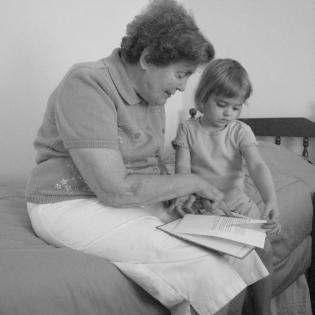
Arrange for each child or pair of children to meet a senior from the retirement community. This may be through an in-person visit, a video call, or a written exchange. In the first exchange, they learn names and each share a memory.
Obtain appropriate permission (and transportation, if in person) for children to meet and talk with a senior friend.
-
Fox, Mem. Wilfrid Gordon McDonald Partridge. New York: Kane/Miller Book Publishers, 1985. ISBN: 0916291049
Instructions
Anticipatory Set:
Pair up children so each child may tell a brief story about the memory object they brought in. Tell them this is practice for sharing their memory with a senior friend.
Make a floor graph with the memory items and compare and discuss the attributes of the memories.
-
As a group, recall the five definitions of memory from the book Wilfrid Gordon McDonald Partridge. Write the definitions as headings for a floor graph: makes you laugh, makes you cry, from long ago, as precious as gold and makes you feel warm. Make a grid large enough for the memory items to be placed in rows and columns. The five headings are placed in the first row.
-
Each child takes a turn placing their object on the graph in the most appropriate column. When the items are place, discuss the statistics of the graph with questions like the following:
-
How many children brought in an item that makes them cry? Makes them laugh?
-
How many children brought in an item that is as precious as gold and is something from long ago?
-
How many more are in ______ column than _________ column?
-
What is the most common type of memory for our group? Do you think it will be the same for our senior friends?
-
Describe the logistics of the first meeting you have arranged with the senior friends. If the first meeting is in writing, guide the children to write or dictate a letter with this template:
Dear Friend,
My name is _____. I am __ years old. How old are you?
One memory I have is __________________________. Tell me about one of your memories.
Please write back. I hope I get to meet you in person so we can share stories.
Your friend,
_________
In later meetings, the children may ask the seniors to tell stories of their philanthropy. What do they care about most in the community, and in what ways do/did they use their time, talent, and treasure for the good of all?
None for this lesson.
