Vision
Learning to Give's vision is a world where all youth are knowledgeable and equipped for lifelong engagement in philanthropy as givers of time, talent, and treasure for the common good.
Mission
Provide materials and support for educators, youth leaders, nonprofits, and families to help youth develop skills and agency for active roles in the community.
Philanthropy Education Empowers Youth
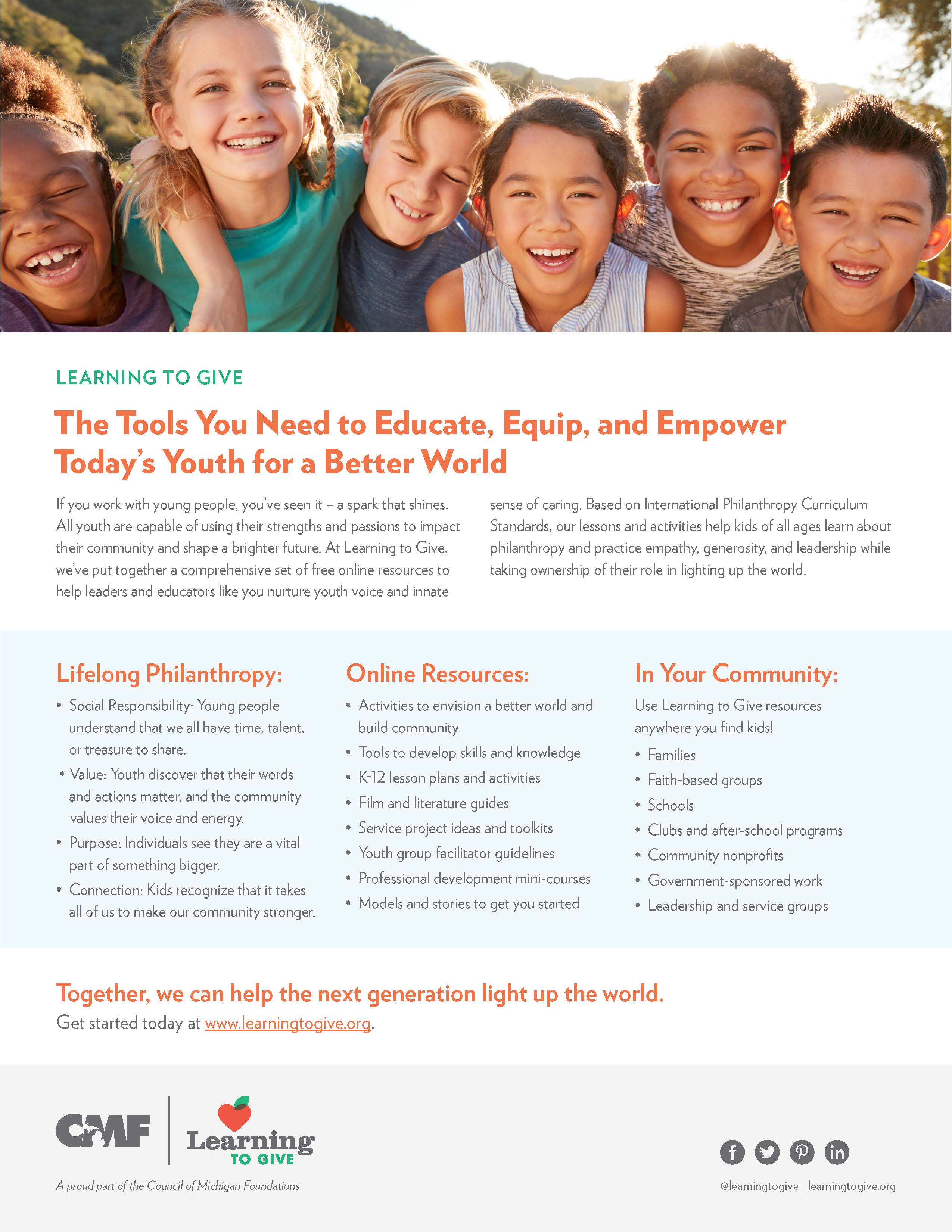
Learning to Give philanthropy education resources help families, educators, youth groups, communities, and youth themselves ...
- educate children and youth to understand their community.
- equip youth with skills and knowledge of philanthropy and civic engagement.
- empower youth to take personal action for the common good.
Follow this journey through the resources under the website menu above:
Build Community > Develop Skills > Take Action.
Based on research-based standards that define what young people should know and be able to do, philanthropy education teaches about civil society and empowers youth action and lifelong engagement.
Why Now?
Now more than ever our world needs every person to be aware of their voice and value to the common good. Whether as volunteers, voters, contributors to a cause, social activists, or leaders, each person's voice is part of a strong and diversely talented civil society envisioning a better world.
The nonprofit sector gives power to all voices and assures we have the arts as well as services for people who are hungry, elderly, or in need. The skills and attitudes necessary to promote civility, community cohesion, and enjoyment of life are skills and experiences found in the civil society sector. Yet an understanding of this sector remains a mystery to many American children.
Proven Quality
Over 25 years of proven quality arise out of Learning to Give's core operating values:
- Put equity at the center of our journey
- Meet youth where they are today
- Use of best practices for youth engagement
- Respect for educators and youth leaders as professionals
- Community-building, abundance
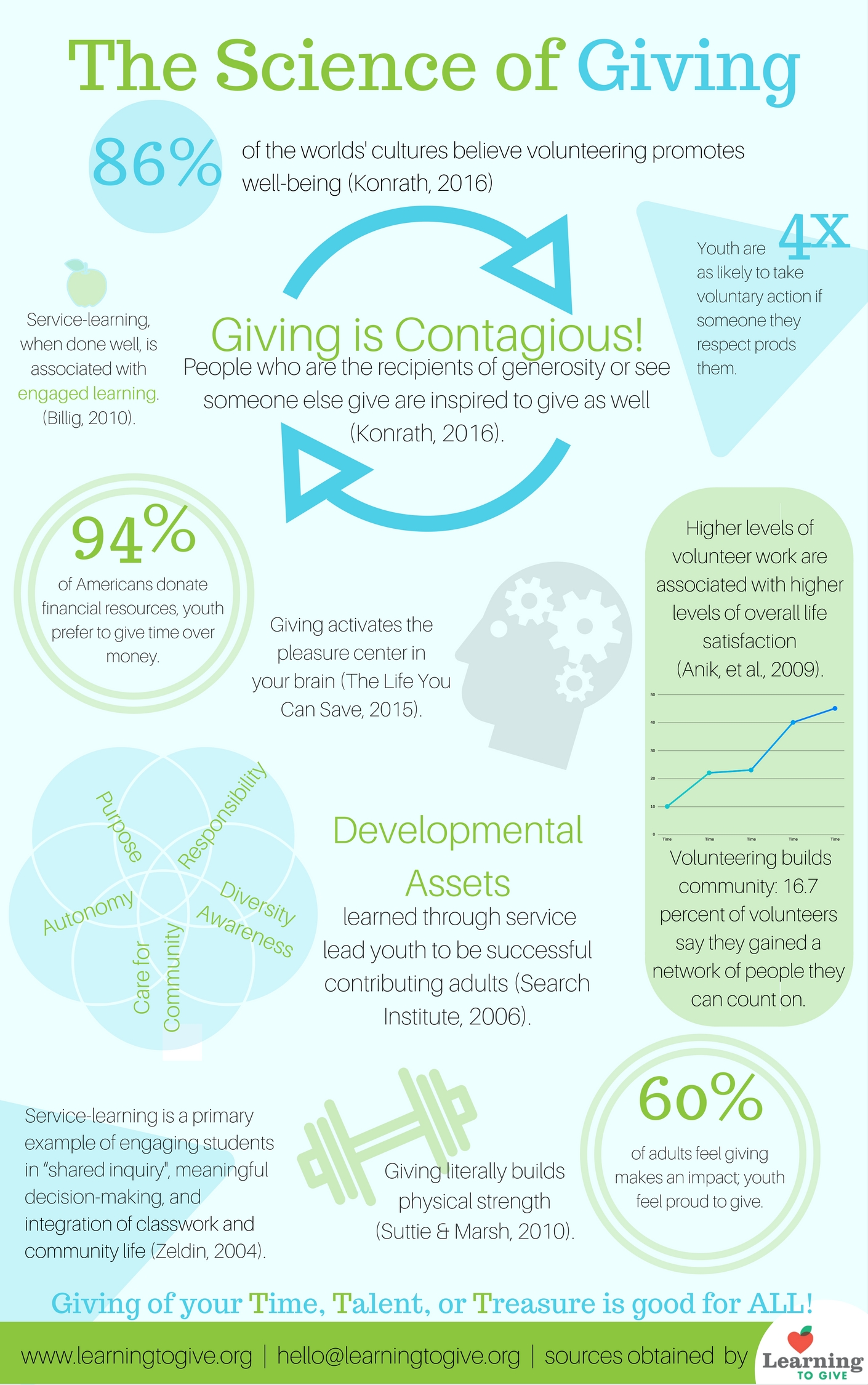
Research tells us to intentionally teach giving.
"Children's empathy, sympathy, and perspective-taking skills develop from around 4 years of age and increase with encouragement" (Ongley et al., 2014).
"If children are involved in action for the benefit of others before the age of 10, they are twice as likely to sustain it throughout their lifetime as young people who only start at age 16-18" (HM Government, 2018).
"While philanthropy is an altruistic impulse, it is also a learned behavior (Falco et al., 1998; Schervish, 1997).
A study by Ottoni-Wilhelm et al. (2014) finds that young people are more likely to give and volunteer if they have been exposed to both conversations about philanthropy and role-modeling of philanthropic behaviors" (IUPUI. p. 9).
When teachers expose students to themes of philanthropy in the Learning to Give lessons, evaluations show that their students exhibit more charitable attitudes, beliefs, and behaviors (MSU, 2006).
"Giving as an act of democratic participation in society is a way in which we can help shape the society we want, rather than simply respond to the need" (Bernholz, 2021).
Youth Agency and Motivation
In today's world, many kids feel isolation and anxiety. They may envision their future based on the limited options they see. Many lack experience in taking responsibility to address conflict and challenges. Often, young people grow up unaware of their community’s assets or the power of the nonprofit sector.
Learning to Give helps youth learn about their communities and how they can help others with their time and talent – their unique gift. Giving promotes happiness and purpose while teaching the givers that they are a vital part of something bigger.
- Youth become aware of needs larger than their own and take action to address them (purpose);
- They are engaged in activities that apply and expand their learning (mastery); and
- Young people take a role in directing their own learning experience (autonomy).
History of Learning to Give
Beginning in 1995, experts in the fields of philanthropic studies, the nonprofit/civil society sector, and a group of 40 classroom teachers from diverse backgrounds wrote the International Philanthropy Curriculum Standards, which became the foundation of Learning to Give. Lessons were specifically designed and regularly vetted by teachers and independently evaluated to meet the need for intentionally teaching the philanthropic traditions and beliefs of civil society.
This timeline shares more details about Learning to Give's history.
In this recorded webinar, hosted by our partner Indiana Philanthropy Alliance, Dwight Burlingame from the Lilly School of Philanthropy describes his participation in the establishment of Learning to Give [description at 5:30 and history at 13:20].
Learning to Give is an endowed program of the Council of Michigan Foundations. CMF leads, strengthens and supports Michigan's community of philanthropy by emboldening and equipping Michigan philanthropy in the relentless pursuit of equitable systems and inclusive diversity, fortifying the field through public policy action, fostering the growth of current and future philanthropy leaders and advancing exemplary philanthropic practices and field expertise.
